Sep. 29, 2026
The core difference between touch foils and infrared touch frames lies in their physical form: the former is a sensing layer adhered to a surface, while the
latter is a standalone frame surrounding the screen. This distinction directly determines their suitability for various scenarios.
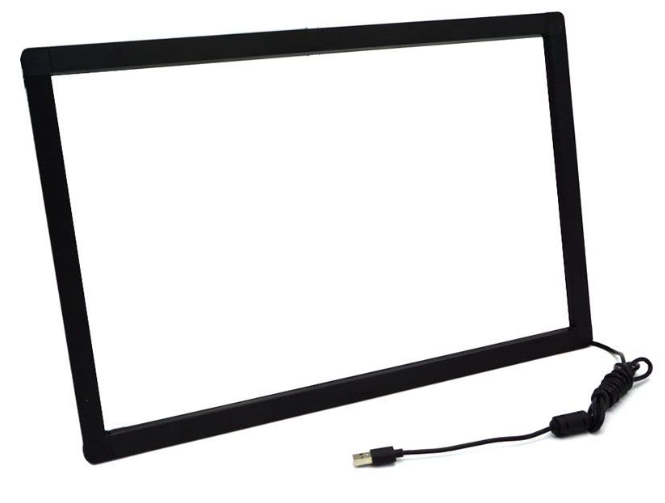
Infrared Touch Frames: A Standard Choice for Rugged Use and Large Public Displays
Infrared touch frames typically consist of four bezel strips forming a rectangular frame mounted in front of the display. Infrared emitters and receivers are
densely arranged within the bezel, creating an invisible grid of intersecting light beams. When a finger or any opaque object enters the grid and obstructs
the light, its position is detected. This technology relies neither on the screen surface itself nor on the electrical conductivity of the touching object.
This operating principle offers several key advantages. First, they exhibit exceptional environmental resilience: operation remains unaffected by gloves,
styluses, or wet hands, and the system is immune to screen surface scratches since touch detection occurs in the air space in front of the display. This
makes infrared touch frames the preferred choice for ATMs, self-service ticketing kiosks, government information terminals, and industrial control
panels—environments where user behavior is unpredictable and equipment is frequently exposed to dust, grease, or outdoor temperature fluctuations.
Second, they offer a significant cost advantage for large-format displays. The frame components can be extended through modular assembly, meaning
costs rise relatively gradually as size increases. Consequently, infrared frames are the standard solution for applications ranging from 60 inches to over
100 inches, such as interactive educational whiteboards, conference displays, digital signage in showrooms, and large-scale command center screens.
They also preserve the screen's original light transmission, ensuring image quality remains unaffected.
Furthermore, infrared touch frames are a convenient option for retrofitting. Existing standard televisions or monitors can be upgraded to touchscreens
simply by attaching an infrared frame, eliminating the need to replace the entire display unit—a popular choice for budget-conscious commercial
upgrades.
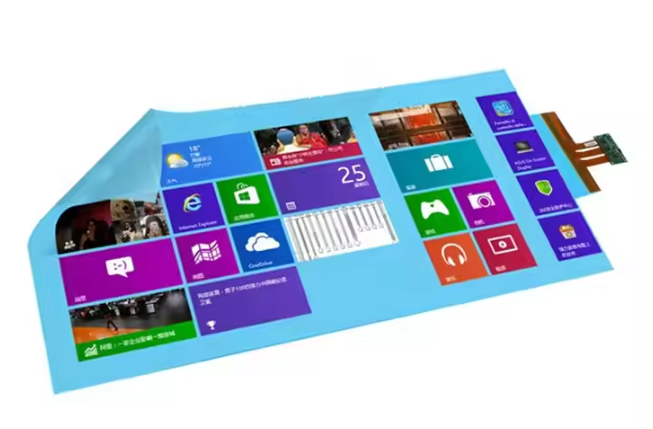
Touch Foils: An Ideal Tool for Invisible Application and Glass-Based Interaction
A touch foil is a transparent, flexible film embedded with a nano-conductive grid or an ITO (Indium Tin Oxide) layer, operating on the principle of
capacitive sensing. It is typically applied to the back of a glass or acrylic panel; touching the glass triggers a change in capacitance, allowing for
precise positioning. Its operational logic differs fundamentally from that of infrared (IR) touch frames.
"Through-glass touch" capability is the touch film's most unique value proposition. In interactive storefront scenarios, merchants apply the film
to the interior side of street-facing windows; paired with indoor projection or displays, this allows passersby to interact directly by touching the
glass from the outside. This solution requires no external frames, preserving the window's aesthetic appeal and ensuring pedestrian traffic remains
unobstructed. Museums and science centers also benefit from this technology in rear-projection glass display cases: with only a layer of glass separating
the exhibit from the viewer—and the touch film concealed behind it—the setup creates an interactive experience akin to a "transparent screen."
Its bezel-free, clean visual profile is another major advantage. Lacking a raised frame, the touch film is virtually invisible, making it ideal for applications
demanding high-quality industrial design, such as smart home control panels, automotive showroom configurators, interactive mirror displays, and
high-end retail kiosks. It can also conform to curved or irregularly shaped glass—capabilities that rigid IR frames struggle to match.
Touch films are also frequently used for quick, small-to-medium-scale retrofitting projects. For instance, standard glass tabletops or acrylic display panels
can be easily upgraded into interactive touch surfaces with manageable costs and simple installation.
**Distinctions and Selection Criteria**
The application boundaries are clear: choose an infrared touch frame for large sizes, high durability, glove-friendly operation, outdoor or harsh
environments, and retrofit projects. Choose a touch film when you need invisible touch capabilities on existing glass, storefront interactivity,
curved surface application, or a sleek, bezel-free aesthetic.
The drawbacks of IR touch frames include their raised bezels and bulky appearance, as well as potential interference with the infrared light path
caused by direct, intense light. Touch films, conversely, face challenges regarding yield rates (which drop as size increases), the requirement for
conductive touch objects (operation with standard gloves is not possible), and the impact of glass thickness on sensitivity.
In practical projects, the choice often hinges on three questions: How large is the screen? How harsh is the environment? How stringent are the
aesthetic requirements? Once these three points are clearly addressed, the technical path naturally becomes evident. The two are not mutually
exclusive alternatives; rather, they are mature solutions within the touch ecosystem that cater to different physical conditions and interaction
requirements.
+0086 755 21042870
+0086 755 2822 5493
Shenzhen Company: 5/F, Building 211, Tairan Science Park, Tairan 4th Road, Shatou Street, Futian District, Shenzhen(518040), China.
Dongguan Factory: 2/F, Building D, Fulin Industrial Park, Weixi Road, Dalingshan Town, Dongguan City(523831), Guangdong,China
NAVIGATION
REQUEST A QUOTE