Oct. 08, 2026
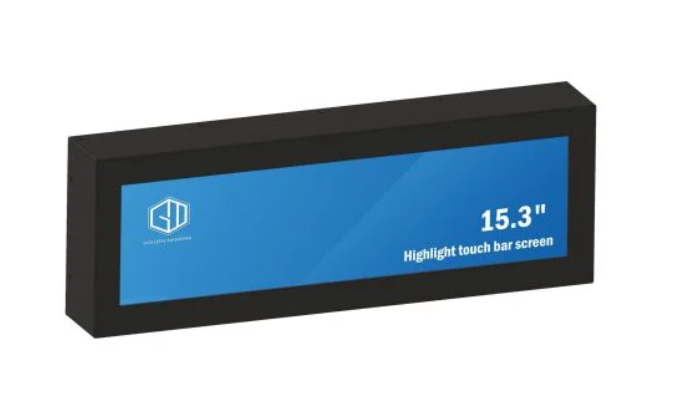
Ultrawide touch displays refer to touch-enabled devices featuring non-standard aspect ratios such as 32:9, 21:9, or 16:2, with common sizes ranging from
29 inches to 105 inches or larger. Leveraging their unique elongated horizontal format, high-brightness industrial-grade panels, and increasingly mature
capacitive touch technology, these products are rapidly penetrating industrial and commercial sectors. From retail shelves and transportation hubs to
factory production lines and command centers, they are gradually establishing a new paradigm for information interaction.
I. Technical Advantages: Spatial Adaptation and Efficiency Reconfiguration
The core value of ultrawide touch displays lies primarily in space utilization efficiency. Utilizing customized pixel configurations and slim mechanical
designs, these stretched displays fit into narrow, elongated installation spaces where traditional 16:9 screens cannot be seamlessly integrated. Compared
to solutions involving tiled standard displays, native ultrawide panels eliminate visual disruptions caused by physical bezels, reduce power consumption
by 50% to 70%, and avoid the waste of obscured screen area inherent in tiled setups.
Secondly, they offer a significant increase in information density. In control room scenarios, for instance, a 21:9 ultrawide screen can simultaneously display
real-time feeds from multiple cameras; operators can grasp the overall situation without frequently switching views, effectively preventing information
loss caused by screen transitions. In office and collaborative environments, a 34-inch 5K ultrawide screen allows multiple application windows to be
opened side-by-side, drastically boosting multitasking efficiency.
Furthermore, ultrawide touch displays integrate interactive capabilities. With technologies ranging from 10-point to 50-point metal-mesh capacitive
touch, touch precision and response speeds have continuously improved, ensuring responsive operation even in industrial environments where users
may be wearing gloves or have wet hands. This "display-plus-interaction" integration makes them an ideal platform for equipment control, self-service
terminals, and collaborative decision-making.
II. Key Industrial and Commercial Application Scenarios
Industrial Manufacturing and HMI Control. Intelligent Manufacturing. In the field of intelligent manufacturing, ultra-wide touch displays are gradually
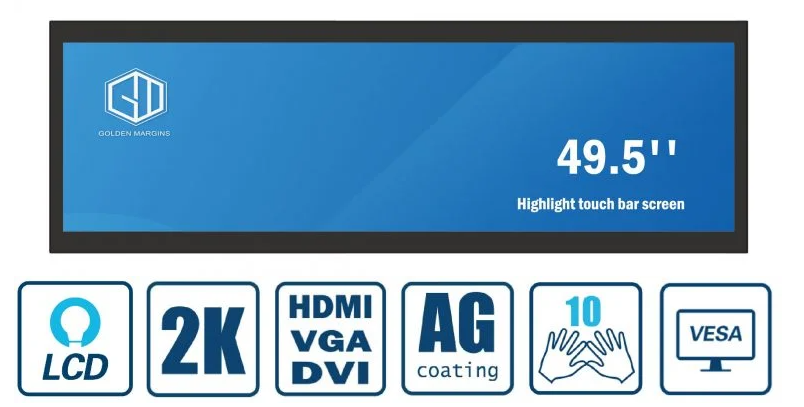
replacing traditional small-format HMI panels and tiled display walls. For instance, in an automotive parts factory, a 49-inch ultra-wide touchscreen
powered by the Kirin system utilizes a multi-layered layout to display key metrics—such as equipment status, production progress, and quality data
—simultaneously. This allows production line managers to oversee operations comprehensively without switching screens, resulting in an 18% increase
in production efficiency. Elsewhere, textile factories in Taiwan have adopted wide-screen HMI panel PCs for production line control, while US oil companies
have deployed industrial touch terminals on offshore platforms to meet rigorous requirements regarding wide voltage ranges and corrosion resistance.
Retail and Food Service. The retail sector is among the fastest-growing markets for ultra-wide stretched displays. 32:9 ultra-wide touchscreens are widely
used for shelf-edge advertising, menu boards, and information kiosks; retailers replace paper price tags with dynamic shelf-edge screens, enabling
real-time updates and remote management of promotional content. In the food service sector, Japanese conveyor-belt sushi chains and yakiniku
(Japanese BBQ) restaurants have deployed 29-inch ultra-wide touch ordering systems. Customers can browse multiple dishes and place orders
simultaneously on the large landscape-oriented screen, overcoming the usability issues associated with traditional small-screen ordering interfaces.
Transportation Hubs and Digital Signage. Demand for ultra-wide displays is equally strong in transportation settings such as airports, subway stations,
and bus stops. A 48.5-inch ultra-wide display with 3840×720 resolution is ideal for information strips in bus shelters, capable of displaying real-time
arrival information for four to six bus routes within a display band just 90 millimeters high. Taiwan's metro system has installed multiple ultra-wide
"TARTAN" displays on platforms and at entrances, replacing traditional LED information screens with 32:9 aspect ratio displays to create a modern,
smart station image.
Command, Control, and Professional Collaboration. In environments such as power grid dispatch centers, rail transit command centers, and public
security surveillance facilities, 21:9 ultra-wide displays enable the simultaneous display and unified management of multiple video feeds on a single
screen. Vtron’s hyper-integrated display system has been deployed at a State Grid dispatch and command center; by deeply integrating AI
technology, it supports one-touch cross-system coordination and automatic fault localization, enabling panoramic monitoring and efficient
collaboration across the backbone power grid. In conference room settings, 92-inch ultra-wide touch displays deliver clear, collaborative visuals
even in brightly lit modern offices, while supporting deep integration with video conferencing and remote collaboration platforms.
III. Development Trends and Prospects
In terms of market size, the global stretched display market is projected to maintain a compound annual growth rate (CAGR) of 8.3% between 2026
and 2033, while the global industrial touchscreen market is expected to grow from $6.8 billion in 2026 to $11.9 billion in 2033. The open-frame touch
display market is also experiencing steady growth; their bezel-free, modular design facilitates integration into customers' own equipment cabinets,
and they offer a full range of sizes from 7 to 55 inches, with IP65 protection and 24/7 continuous operation becoming standard procurement requirements.
Regarding technological innovation, continuous breakthroughs in high-brightness panels are noteworthy. Planar’s 21:9 5K display series, for instance,
achieves a peak brightness of 2,500 nits and VESA DisplayHDR 1400 certification, ensuring clear visuals even in bright commercial lobbies or retail spaces.
Meanwhile, AI capabilities are migrating to the edge; open-frame display terminals integrated with edge computing power can support footfall analytics,
intelligent interaction, and remote device maintenance, driving the transformation of ultra-wide touch displays from mere "display windows" into "
intelligent nodes."
It is foreseeable that as Industry 4.0 deepens and the digital signage market continues to expand, ultra-wide touch displays will evolve beyond niche,
customized products to become a vital component of industrial and commercial information interaction infrastructure, unlocking their unique value
across a wider range of applications.
Previous None
Next Different Applications of Touch Foils and Infrared Touch Frames
+0086 755 21042870
+0086 755 2822 5493
Shenzhen Company: 5/F, Building 211, Tairan Science Park, Tairan 4th Road, Shatou Street, Futian District, Shenzhen(518040), China.
Dongguan Factory: 2/F, Building D, Fulin Industrial Park, Weixi Road, Dalingshan Town, Dongguan City(523831), Guangdong,China
NAVIGATION
REQUEST A QUOTE