May. 20, 2026
Touchscreen technology is profoundly transforming the public transportation experience, playing an increasingly vital role in both public buses and
integrated transportation systems.
I. Applications on Public Buses: Enhancing the Riding Experience
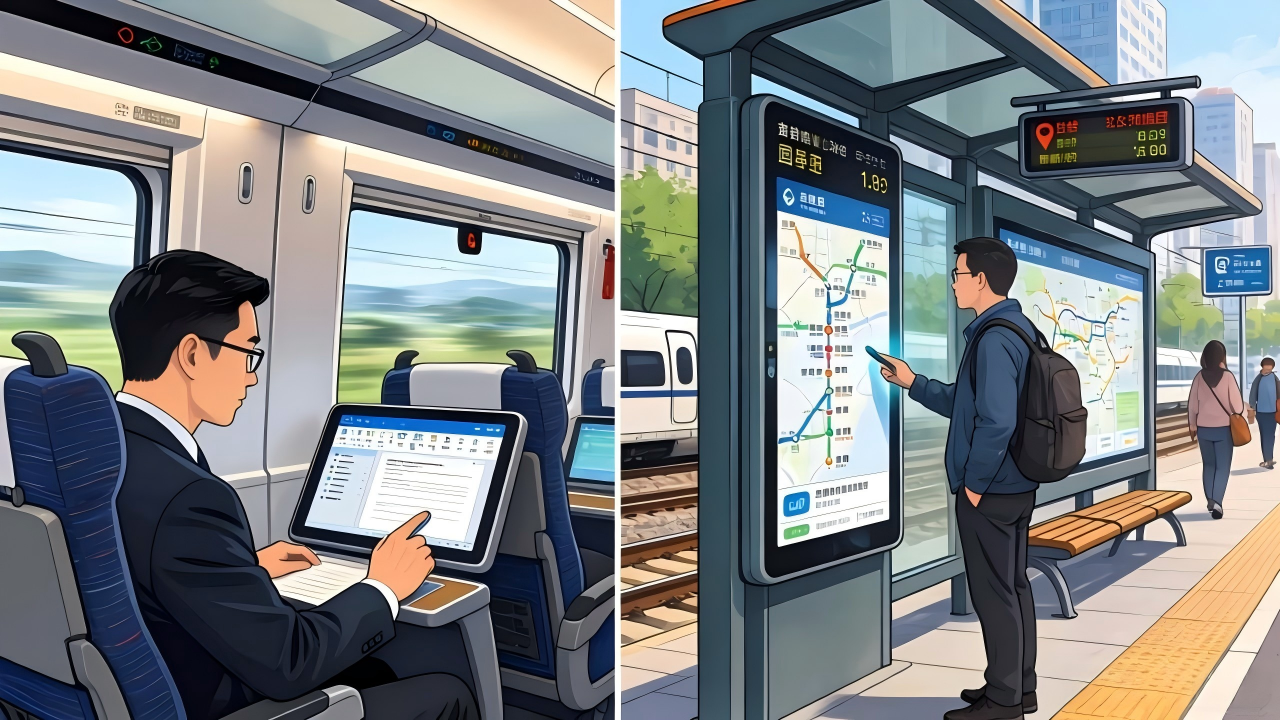
On public buses, touchscreens primarily serve the needs of both drivers and passengers.
· Intelligent Dispatch Terminals: Touchscreens have replaced traditional physical buttons, integrating functions such as route monitoring, in-vehicle
camera feeds, and communication with the dispatch center. This enables drivers to efficiently complete tasks—such as clocking in and conducting
vehicle condition checks—while simultaneously optimizing the layout of the driver's cabin.
· Passenger Information and Interaction Systems:
· Interactive Electronic Bus Stops: Passengers can use touch interfaces to access information regarding route planning, transfers, and estimated arrival
times, as well as zoom in and out on map details. Compared to traditional information displays, these systems offer richer content and allow for
personalized inquiries.
· Multimedia Entertainment and Services: On long-distance coaches, seat-back screens allow passengers to access on-demand audio-visual content and
provide useful information such as destination weather forecasts and hotel listings.
II. Expanded Applications in Integrated Transportation Systems
In subway networks, high-speed rail systems, and major transportation hubs, the applications of touchscreen technology are even more extensive.
· Self-Service Ticketing, Collection, and Information Terminals: Whether through automated ticket machines in subway stations or comprehensive
information kiosks in airports and train stations, these systems rely on touchscreens to facilitate real-time, accurate schedule inquiries and self-service
ticket purchases, thereby alleviating pressure on manned service counters.
· Smart Waiting Areas and Wayfinding: Interactive touchscreen maps located within major hubs provide indoor navigation assistance, helping travelers
locate entrances, shops, or restrooms. Advanced screens can even utilize facial recognition technology to enable "face-scan" entry or provide personalized
boarding reminders.
· Maintenance and Diagnostics: Maintenance personnel can utilize industrial-grade touchscreen tablets to quickly access vehicle circuit diagrams or fault
diagnostic reports, thereby significantly improving maintenance efficiency.
III. Core Value and Challenges
· Core Value: Enhancing efficiency (simplifying operational workflows), optimizing the user experience (providing personalized information services), and
improving safety (reducing driver distraction).
· Challenges Faced:
· Durability: Systems must withstand harsh environmental conditions, including high temperatures, vibrations, and dust.
· Reliability: Systems must guarantee long-term stable operation and remain free from system crashes or freezes. · Operational Feedback: Touchscreens
lack tactile physical feedback, making "blind operation" (operating without looking) difficult; furthermore, precise tapping may be compromised while
traveling in a vehicle subject to bumps and vibrations. Consequently, core driving functions should still retain physical buttons as a backup measure.
· Accessibility Design: Specific optimizations—such as larger font sizes and voice prompts—are required to facilitate usage by the elderly and individuals
with visual impairments.
Overall, touchscreen technology is driving public transportation toward greater intelligence and digitalization. Although challenges persist regarding
environmental adaptability and human-machine interaction, through optimized design (such as the incorporation of haptic feedback and enhanced
durability) and integration with technologies like 5G and AI, this technology promises to deliver a more efficient and user-friendly travel experience
for the public.
+0086 755 21042870
+0086 755 2822 5493
Shenzhen Company: 5/F, Building 211, Tairan Science Park, Tairan 4th Road, Shatou Street, Futian District, Shenzhen(518040), China.
Dongguan Factory: 2/F, Building D, Fulin Industrial Park, Weixi Road, Dalingshan Town, Dongguan City(523831), Guangdong,China
NAVIGATION
REQUEST A QUOTE