May. 14, 2026
Selecting the appropriate digital window display screen requires a comprehensive assessment across three key dimensions: "Application Scenario," "CoreTechnical Parameters," and "Content Requirements." When making a purchase, consider following this four-step approach:
Step 1: Define the Scenario, Calculate the Distance
This is the foundational step, primarily determined by the device's installation location and the viewing distance of the target audience.
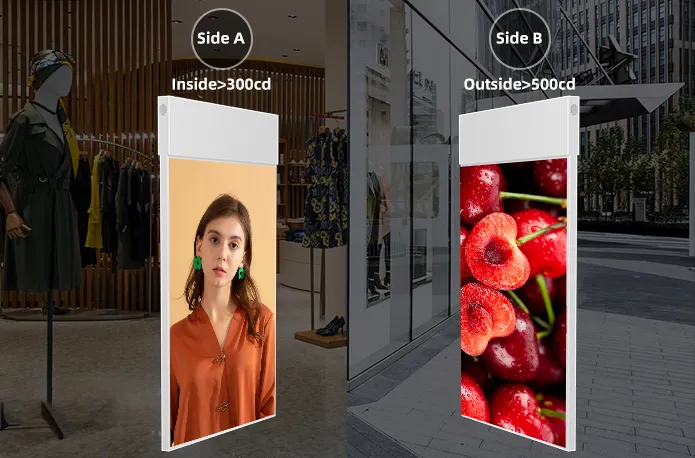
· Indoor Environments: For settings such as service counters or in-store display windows, it is advisable to select LCD or OLED screens with high color
fidelity to ensure a more comfortable viewing experience. Brightness levels typically range from 800 to 1500 nits to prevent glare.
· Outdoor/Window-Facing Settings: These environments face direct sunlight and weather challenges, necessitating the use of LED screens.
· Distance Formula: Optimal Viewing Distance (meters) ≈ Pixel Pitch (mm) × 1.5. For example, a P4 screen is suitable for viewing from a distance of
approximately 6 meters, while a 32-inch screen performs best when viewed from 1.5 to 2 meters away.
Step 2: Select Brightness, Define Performance
Once the screen type has been determined, focus on locking in the two most critical technical parameters:
· Brightness Suitability: For indoor use, 250–1500 nits is sufficient; semi-outdoor settings require 1500–3000 nits; if the screen faces direct sunlight, its
brightness must be boosted to over 3000 nits.
· Resolution and Refresh Rate: For displaying core information, a resolution of 1080P (Full HD) or higher is recommended to ensure clarity. If the display
is intended to be filmed or photographed without flickering, the refresh rate should be ≥3840Hz.
Step 3: Enhance Integration, Foster Interaction
If the device is intended for applications such as queue management or sales assistance, its functional "Role" becomes even more critical than its technical
"Parameters":
· Integrated Queue Management and Service: A 32-inch screen offers the most comfortable viewing experience at a distance of 1.5 to 2 meters. It can be
integrated with online appointment systems (e.g., via WeChat) to minimize "ineffective communication" and has the potential to reduce the psychological
anxiety associated with queuing by over 40%.
· Touch Capabilities and Smart Control: It is recommended to utilize large-format screens equipped with multi-touch capabilities. Prioritize devices that
feature an integrated cloud management platform, facilitating convenient remote content updates, real-time brightness adjustments, and remote
troubleshooting.
Step 4: Evaluate the Brand and After-Sales Support
Finally, do not forget to consider quality and service:
· Brand and Reliability: For indoor applications, consider brands such as LG or AOC; for high-end commercial environments, Samsung or Sony are
excellent choices. Reputable brands typically offer LED lamp bead lifespans of up to 100,000 hours.
· After-Sales Commitment: Be sure to verify the manufacturer's warranty period (typically 3–5 years), on-site repair response time (e.g., within 24 hours),
and whether local spare parts inventory is available.
In summary, there is no such thing as a "perfect" screen—only the screen that is best suited to your specific needs. We hope this guide helps you make an
informed decision and achieve a satisfactory return on your investment.
+0086 755 21042870
+0086 755 2822 5493
Shenzhen Company: 5/F, Building 211, Tairan Science Park, Tairan 4th Road, Shatou Street, Futian District, Shenzhen(518040), China.
Dongguan Factory: 2/F, Building D, Fulin Industrial Park, Weixi Road, Dalingshan Town, Dongguan City(523831), Guangdong,China
NAVIGATION
REQUEST A QUOTE