Jul. 09, 2026
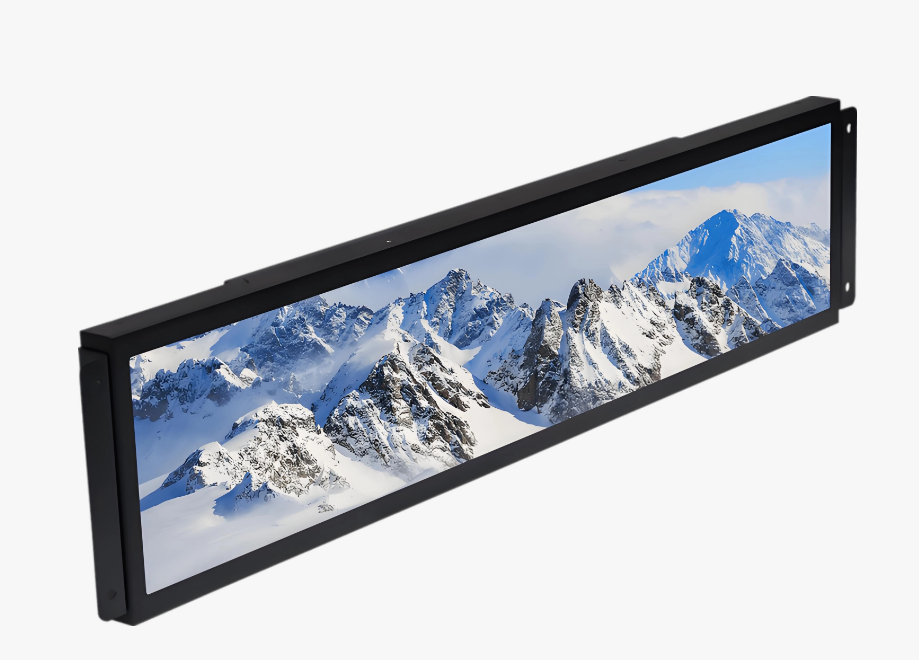
When customizing bar-type LCD screens, it is essential to consider five key dimensions: application scenarios, core specifications, functional interfaces,
structural environment, and manufacturer selection.
1. Define Application Scenarios and Requirements
This serves as the foundation for customization and dictates the direction of all subsequent specifications.
* Usage Location: Indoor (e.g., shopping malls, elevators) or outdoor (e.g., bus stops)?
* Primary Function: Pure information display or interactive touch capabilities?
* Display Content: Static images, dynamic video, or real-time data?
2. Core Performance Specifications
* Size and Aspect Ratio: The defining feature of bar-type screens is their non-standard aspect ratio (e.g., 16:3, 32:9). Specific dimensions must be
determined based on the installation space and visual design.
* Resolution: Resolution must be matched to the physical screen size and application scenario to ensure sufficient pixel density (PPI) and avoid
a grainy image. For example, a 32-inch screen with 3840x600 resolution achieves a PPI of 138, ensuring no graininess at a viewing distance of one
meter. Crucially, UI design must be executed at a 1:1 ratio with the physical resolution to prevent image stretching or distortion.
* Brightness: A critical indicator of environmental adaptability. Indoor settings typically require 300–500 cd/m²; areas near windows or with strong
lighting need 700–1000 cd/m²; and outdoor locations with intense sunlight require over 1500 cd/m².
* Viewing Angle: Public venues require clear visibility from multiple angles; therefore, wide-viewing-angle panels such as IPS (typically offering 178°)
should be selected.
* Contrast and Color: High contrast makes images more vivid, while high color saturation is particularly important for advertising displays.
3. Functions and Interfaces
* Touch Functionality: Choose between resistive touch (low cost, suitable for industrial environments) and capacitive touch (superior user experience,
suitable for interactive applications) based on requirements.
* System and Software: Select between Android (mainstream, open ecosystem, ideal for retail) and Windows (suitable for complex software). Confirm
support for software features such as remote content management (CMS) and multi-screen synchronization.
* Input Interfaces: Ensure the inclusion of necessary interfaces—such as HDMI, VGA, USB, and Ethernet—to facilitate integration with existing systems.
4. Structural and Environmental Adaptability
* Mounting Method: Determine whether wall-mounted, suspended, or embedded installation is required to design the appropriate housing and brackets.
* Ingress Protection (IP) Rating: For outdoor or harsh environments, prioritize water and dust resistance (e.g., IP65 rating).
* Operating Temperature: Outdoor applications require industrial-grade panels capable of stable operation across a wide temperature range (e.g., -30°C
to 85°C).
* Heat Dissipation and Power Consumption: Consider thermal management and power consumption for long-term operation.
* Housing Material: Select materials based on the environment—such as metal (durable with good heat dissipation) or plastic (lightweight).
5. Selecting a Reliable Supplier
* Technical Expertise: Since bar-type displays are often created by cutting standard panels, the manufacturer's capabilities in cutting, edge sealing, and
circuit modification directly impact product quality and lifespan.
* Panel Source: Verify the brand (e.g., Samsung, LG, AUO) and grade (e.g., Grade A) of the LCD panels used.
* Customization Experience: Choose a manufacturer with extensive experience in non-standard customization.
* After-Sales Service: Confirm warranty policies and the availability of long-term technical support.
In summary, customizing bar-type LCD displays is a comprehensive process. From defining requirements and confirming core specifications, functional
interfaces, and structural designs, to selecting a technically proficient partner, every step influences the success of the final product.
+0086 755 21042870
+0086 755 2822 5493
Shenzhen Company: 5/F, Building 211, Tairan Science Park, Tairan 4th Road, Shatou Street, Futian District, Shenzhen(518040), China.
Dongguan Factory: 2/F, Building D, Fulin Industrial Park, Weixi Road, Dalingshan Town, Dongguan City(523831), Guangdong,China
NAVIGATION
REQUEST A QUOTE