Nov. 25, 2026
The core value of stretched bar-type LCD screens lies not in being "longer," but in being "perfectly adapted." In narrow, elongated spaces—such as the
edges of retail shelves, the headers above vehicle doors, or the sides of home appliances—traditional 16:9 displays either fail to fit or leave behind large,
unusable gaps. Stretched bar-type displays, created either through native bar-format panel manufacturing or by precision-cutting and re-packaging
standard panels, fit seamlessly into these "leftover" spaces, transforming previously wasted, narrow areas into effective information interfaces. This
logic of spatial adaptation dictates how these displays penetrate various industries.
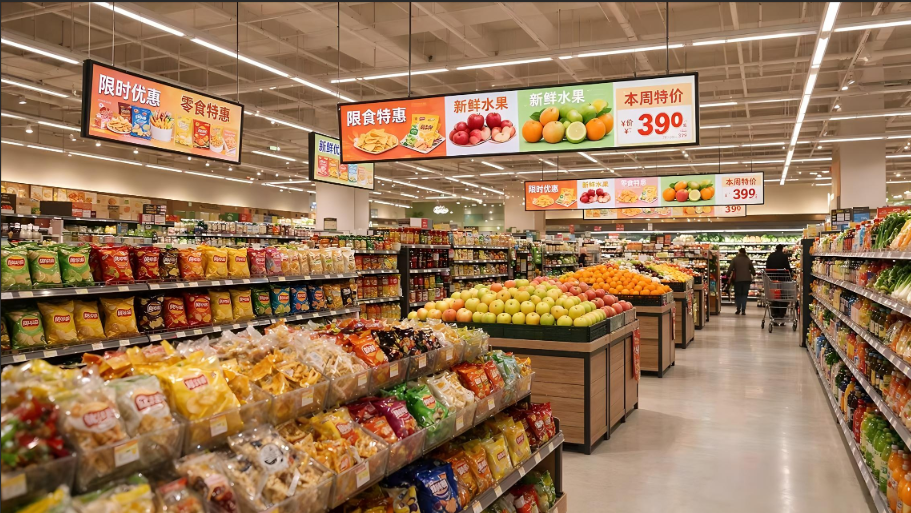
Smart retail is the sector with the highest density of stretched bar-type display deployments. Locations such as supermarket shelf edges, end-caps,
checkout counters, and the tops of refrigerated cabinets—characterized by ample width but extremely limited height—are ideal settings for these
screens. Here, they function as dynamic price tags, promotional displays, and product specification boards, replacing static paper labels while
enabling remote content updates. When integrated with the Internet of Things (IoT), they can facilitate dynamic pricing and real-time inventory
synchronization. Case studies show that for convenience store chains, such deployments have reduced losses from out-of-stock items by 65%
and improved price-adjustment efficiency by 90%. In the high-brightness environments typical of retail stores, these screens can achieve
brightness levels of 1,000–3,000 cd/m², ensuring content remains legible even under intense lighting.
In public transportation, the reliance on bar-type displays stems from the rigid structural constraints of vehicle interiors. Spaces above subway
doors, between windows, or along the ceilings of buses are narrow and elongated—dimensions that conventional displays cannot accommodate.
In these settings, bar-type displays serve a dual purpose: providing passenger information and displaying commercial advertisements. Screens
above doors typically show dynamic route maps and arrival information, while those positioned between windows can display independent
commercial content. In the event of an emergency, all screens can be switched instantly to provide evacuation guidance, allowing for the
segmented management of operational information and commercial advertising. Automotive environments demand a wide operating
temperature range (-30°C to 80°C), vibration resistance, and a long service life—typically requiring a backlight lifespan of over 50,000 hours
to accommodate daily usage of 18–20 hours.
In automotive and smart cockpit applications, the focus shifts to an "optimal placement" logic. A 1.5-inch curved bar display can be integrated
into the steering wheel (at the 3 o'clock or 9 o'clock positions) to show real-time data such as engine RPM, vehicle speed, and navigation arrows,
allowing drivers to keep their eyes on the road. A 7-inch touchscreen bar located at the front of the center console armrest can consolidate
controls for air conditioning, seats, and windows; by combining pressure-sensitive input with touch-based sliding, the rate of accidental
activation can be reduced by 75%. Furthermore, a bar display atop the dashboard can provide redundancy for an AR-HUD (Augmented
Reality Head-Up Display), taking over the presentation of critical alerts if strong ambient light interferes with the HUD projection. In this
context, the bar display is not merely "another screen," but an information touchpoint strategically embedded along the driver’s natural
line of sight.
Smart home appliances represent one of the fastest-growing sectors for bar displays. Whether it is a control strip on a range hood or integrated
cooktop, a freshness status indicator on the edge of a refrigerator door, a program display on a washer/dryer, or a status panel on a smart toilet,
these applications share a common constraint: the appliance's physical structure is already fixed, leaving only a narrow slot for a display. 7–8 inch
vertical bar-type modules can be integrated without requiring a complete redesign of the appliance. Their wide operating temperature range
(-20°C to 70°C) and brightness levels of 600–700 cd/m² make them well-suited for the high-temperature, high-glare environment of a kitchen
or the humid conditions of a bathroom. In a smart home ecosystem, these displays can also serve as auxiliary control panels positioned next
to standard light switches—organizing lighting, curtains, and preset "scenes" in a vertical layout to provide an additional interface for wall-mounted
interaction.
Public and professional settings further expand the reach of bar-type displays. In settings such as bank service counters, hospital triage areas, and
government service halls, elongated (bar-type) displays are increasingly replacing traditional monochrome LED dot-matrix screens. These displays
fit into the same narrow, horizontal mounting spaces while offering full-color, dynamically updated content that can be managed remotely. Similarly,
bar-type advertising screens in elevators, wayfinding displays in airports and shopping malls, and status-monitoring panels for industrial control
systems leverage their slim bezels and versatile mounting options—including wall-mounting, flush-mounting, and suspension—to add an extra layer
of information without disrupting the existing functionality of the space.
Technologically, these displays fall into two categories: native bar-type panels and cut-from-standard panels. The former are manufactured to specific
aspect ratios by the panel producer, offering high consistency and suitability for large-scale, stable projects. The latter are created by cutting and
re-encapsulating standard-sized panels, providing greater dimensional flexibility for custom equipment with constrained physical space. With brightness
levels ranging from 300 cd/m² for indoor use to over 2,000 cd/m² for semi-outdoor environments, and an operating temperature range spanning -30°C to
85°C, the same display form factor can be deployed across diverse sectors, including retail, transportation, industrial operations, and home appliances.
The expanding application of these elongated displays reflects a broader shift in display technology: moving from screens that require the environment
to adapt to them, toward screens that adapt to the environment—thereby unlocking a vast array of new, embeddable use cases.
Previous None
+0086 755 21042870
+0086 755 2822 5493
Shenzhen Company: 5/F, Building 211, Tairan Science Park, Tairan 4th Road, Shatou Street, Futian District, Shenzhen(518040), China.
Dongguan Factory: 2/F, Building D, Fulin Industrial Park, Weixi Road, Dalingshan Town, Dongguan City(523831), Guangdong,China
NAVIGATION
REQUEST A QUOTE


Scan to wechat