Aug. 12, 2026
In the field of touchscreen manufacturing, the lamination process directly determines the screen's display quality, durability, and cost. The two
mainstream processes—full lamination and frame lamination—each have distinct advantages and disadvantages, making them suitable for
vastly different use cases.
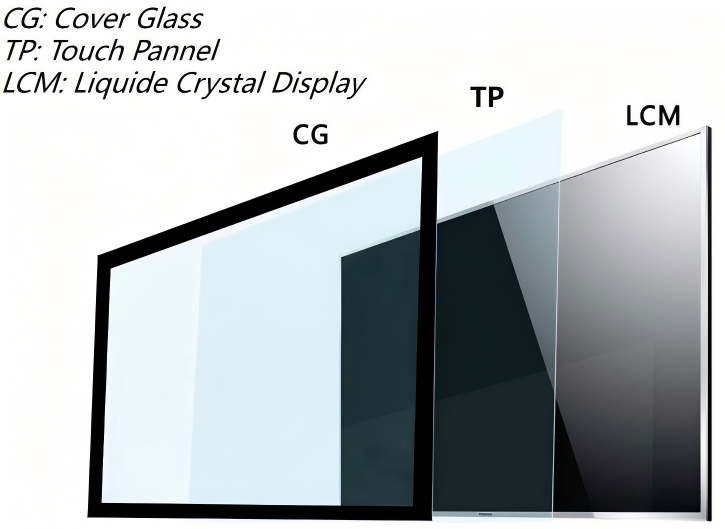
I. Frame Lamination: A Low-Cost, Traditional Solution
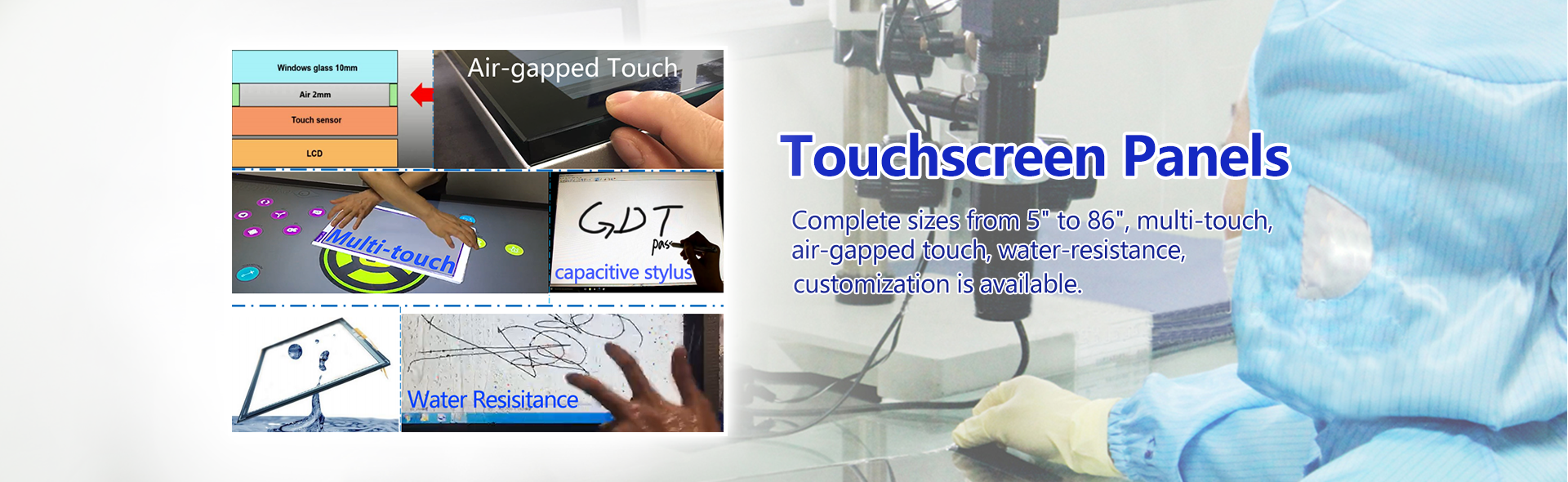
Frame lamination (also known as "perimeter bonding" or "tape bonding") involves using double-sided adhesive to bond the edges of the
touchscreen to the display panel, leaving an air gap in the center.
Advantages of Frame Lamination:
First, the cost is very low. It utilizes standard double-sided tape and metal frames; materials are inexpensive, the process is simple, and the technical
barrier to entry is low—it can even be performed manually without expensive equipment. For instance, the frame lamination cost for an 86-inch large
screen can be under 200 RMB. Second, maintenance is convenient; the touchscreen and display panel can be separated and replaced individually,
so localized damage does not require scrapping the entire unit. Additionally, the process is mature, offers high yields, and has a short production cycle,
making it ideal for mass production.
Disadvantages of Frame Lamination:
First, display quality is poor. The air gap causes multiple light reflections at the glass-air interface, resulting in a washed-out appearance and low contrast.
Under strong outdoor light, reflections are severe, rendering the image almost unreadable. Second, light refraction as it passes through the air gap causes
parallax and image displacement. Third, protection is weak; relying solely on edge adhesive strips allows dust and moisture to easily penetrate, leading to
internal fogging, dust accumulation, or even short circuits over time. Fourth, the touch experience is suboptimal; the air gap interferes with signals,
potentially causing latency or accidental touches.
II. Full Lamination: A High-End Choice for Performance
Full lamination involves using OCA (Optically Clear Adhesive) or LOCA (Liquid Optically Clear Adhesive) to seamlessly bond the touchscreen to the display
panel, completely eliminating the air gap.
Advantages of Full Lamination:
First, display quality is exceptional. By eliminating the air gap—and because the refractive index of the optical adhesive is close to that of glass—light
reflection is drastically reduced. This results in a clear, high-contrast image that remains visible even under strong outdoor light. Second, protection
is robust; the seamless bonding structure completely prevents the ingress of dust and moisture. Third, the structure is more robust; the integrated
molding significantly enhances impact and vibration resistance. Fourth, the device profile is thinner; full lamination adds only 25–50 μm in thickness,
making it 7–10 mm thinner than frame bonding. Fifth, touch performance is more precise; signal transmission is lossless with sensitive response,
and panel noise interference with touch functionality is effectively minimized.
Disadvantages of full lamination:
First, costs are high. It requires expensive optical adhesives and specialized equipment, with precision bonding, heat pressing, and de-bubbling
processes carried out in cleanrooms. Yield rates are generally below 80%, and the success rate for rework is under 40%. Second, repair is difficult;
since the touch layer and display layer are fused into a single unit, localized damage necessitates replacing the entire assembly, resulting in high
after-sales costs.
III. Summary Comparison
| Comparison Dimension | Frame Bonding | Full Lamination |
| Display Quality | Whitish cast, significant reflection | Clear and transparent, visible in bright light |
| Dust/Moisture Resistance | Poor; prone to dust ingress and fogging | Excellent; fully sealed |
| Structural Strength | Average | Integrated; robust and durable |
| Device Thickness | Thicker | Thinner |
| Touch Experience | Potential lag or accidental touches | Precise and responsive |
| Cost | Low | High |
| Repair | Individual component replacement | Full assembly replacement |
Selection Recommendations: Frame bonding is suitable for indoor environments with standard temperatures, limited budgets, and moderate display
requirements. Full lamination is the more reliable choice for outdoor, automotive, high-humidity/dusty, or high-vibration environments, or where
high-precision touch performance is required.
+0086 755 21042870
+0086 755 2822 5493
Shenzhen Company: 5/F, Building 211, Tairan Science Park, Tairan 4th Road, Shatou Street, Futian District, Shenzhen(518040), China.
Dongguan Factory: 2/F, Building D, Fulin Industrial Park, Weixi Road, Dalingshan Town, Dongguan City(523831), Guangdong,China
NAVIGATION
REQUEST A QUOTE



Scan to wechat