Oct. 29, 2026
The choice between USB and I²C interfaces for touchscreens is, at its core, a decision regarding system integration strategy: should the complexity reside
on the touch controller side (USB), or should it be managed by the host controller and software team (I²C)? Since both interfaces provide equivalent
touch coordinate data, the selection for industrial equipment is ultimately determined by how well each option aligns with the system architecture,
platform, and specific project constraints.
Communication Architecture: Where Does the Complexity Lie?
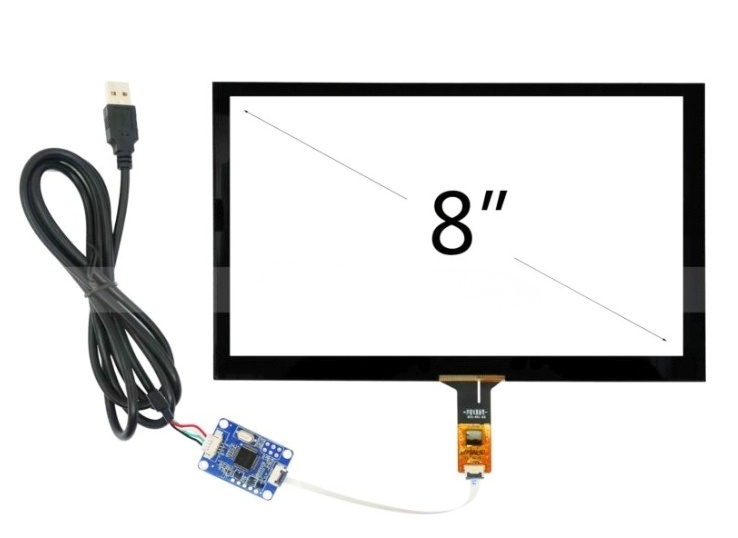
USB touchscreens typically adhere to the HID (Human Interface Device) protocol. The touch controller incorporates a robust MCU and firmware, which
encapsulates touch coordinates into standard input reports, placing virtually "zero" requirements on the host controller. In contrast, I²C operates as a
master-slave bus; the touch controller acts as a slave device, relying on the host to actively poll for data. Consequently, tasks such as driver adaptation,
interrupt handling, and device tree configuration fall to the host side. In short, USB keeps complexity and costs at the touchscreen level, while I²C shifts
that complexity—along with the associated debugging workload—onto the mainboard and software team.
Compatibility: Plug-and-Play vs. Deep Integration
The primary advantage of USB is its cross-platform, "driver-free" nature. Whether used with a Windows-based industrial PC, a Linux-based embedded
board, or an Android terminal, any system supporting USB HID can generally recognize the device immediately, making it the lowest-risk option for
multi-platform environments or projects intended for export. I²C, however, is deeply coupled with the host platform: the host must expose an I²C bus,
and because register maps and driver models vary between different touch chips, switching platforms often necessitates significant software re-adaptation.
For teams with a fixed platform and strong embedded development capabilities, I²C presents no issue; however, for projects requiring multi-platform
delivery or rapid deployment, USB offers far greater integration certainty.
Performance and Reliability: A Critical Distinction in Industrial Settings
USB generally outperforms I²C in terms of noise immunity and stability. I²C is a short-range, board-level bus with relatively weak resistance to interference,
making it more susceptible to disruption in industrial environments characterized by complex electromagnetic conditions. USB utilizes differential
signaling, which provides superior noise immunity and stability—making it the better choice for industrial equipment and commercial terminals that
demand high levels of reliability. Naturally, the advantage of I²C lies in its low power consumption and minimal wiring requirements: it uses only two
signal lines—SDA and SCL—making it ideal for space-constrained, battery-powered, or low-power portable instruments. In contrast, USB requires
differential signal pairs and a complete physical layer (PHY) circuit, resulting in larger connector dimensions and higher power consumption.
Cost: Unit Price vs. Total Cost of Ownership (TCO)
I²C touch modules are generally more affordable, benefiting from lower chip costs and the absence of USB-related licensing fees. USB-based touchscreens
carry a higher unit price, reflecting the cost of more powerful controller MCUs, HID firmware development, and cross-platform stability validation. However,
when considering the total cost, the time saved by avoiding host-side driver development and on-site debugging with USB often offsets—or even exceeds—
the initial price difference. This is especially true for projects with limited development resources or tight delivery schedules.
Selection Guide for Industrial Equipment
Choose USB when:
· The host controller is a Windows-based industrial PC, a standard industrial PC, or a general-purpose x86/ARM motherboard, and the priority is "plug-
and-play" functionality with minimal integration risk.
· The device requires an external touch display where the display and touch channels are separate; USB provides an independent data path for touch
input.
· The project involves cross-platform deployment or international markets, where software adaptation variables must be minimized.
· The operating environment features significant electromagnetic interference (EMI), necessitating high touch stability.
Choose I²C when:
· The host controller is an MCU or a fixed embedded platform (e.g., STM32, ESP32), and the development team possesses the expertise to write device
drivers.
· The device has a compact form factor and is sensitive to power consumption—such as portable instruments or small HMI modules—where the
two-wire, low-power nature of I²C is indispensable.
· The system platform is stable and long-term, with cost optimization as the primary objective, and there is no requirement for frequent changes
to the host controller architecture.
A Middle-Ground Solution: Dual-Interface Modules. Many industrial touchscreens come equipped with both USB and I²C interfaces. This allows for
platform transitions without needing to replace the entire module—an ideal solution for product lines that span multiple platforms or require
variations across different production batches.
In industrial applications, there is no "better" interface—only the one that best aligns with your system architecture. USB trades off cost and
complexity on the display side for integration certainty and cross-platform stability; I²C, by requiring greater development effort on the host
side, offers advantages in terms of low power consumption, compact size, and reduced bill-of-materials (BOM) costs. By first assessing your
host platform and software capabilities, and then weighing these against your specific deployment environment and delivery schedule,
the right choice will usually become clear.
Previous None
+0086 755 21042870
+0086 755 2822 5493
Shenzhen Company: 5/F, Building 211, Tairan Science Park, Tairan 4th Road, Shatou Street, Futian District, Shenzhen(518040), China.
Dongguan Factory: 2/F, Building D, Fulin Industrial Park, Weixi Road, Dalingshan Town, Dongguan City(523831), Guangdong,China
NAVIGATION
REQUEST A QUOTE


Scan to wechat