Dec. 17, 2025
While industrial and commercial capacitive touchscreens share similar technical principles, their core design goals and usage philosophies differ significantly.
Industrial screens prioritize absolute reliability and durability under extreme conditions, while commercial screens focus on providing users with an
exceptional interactive experience and aesthetic appeal.
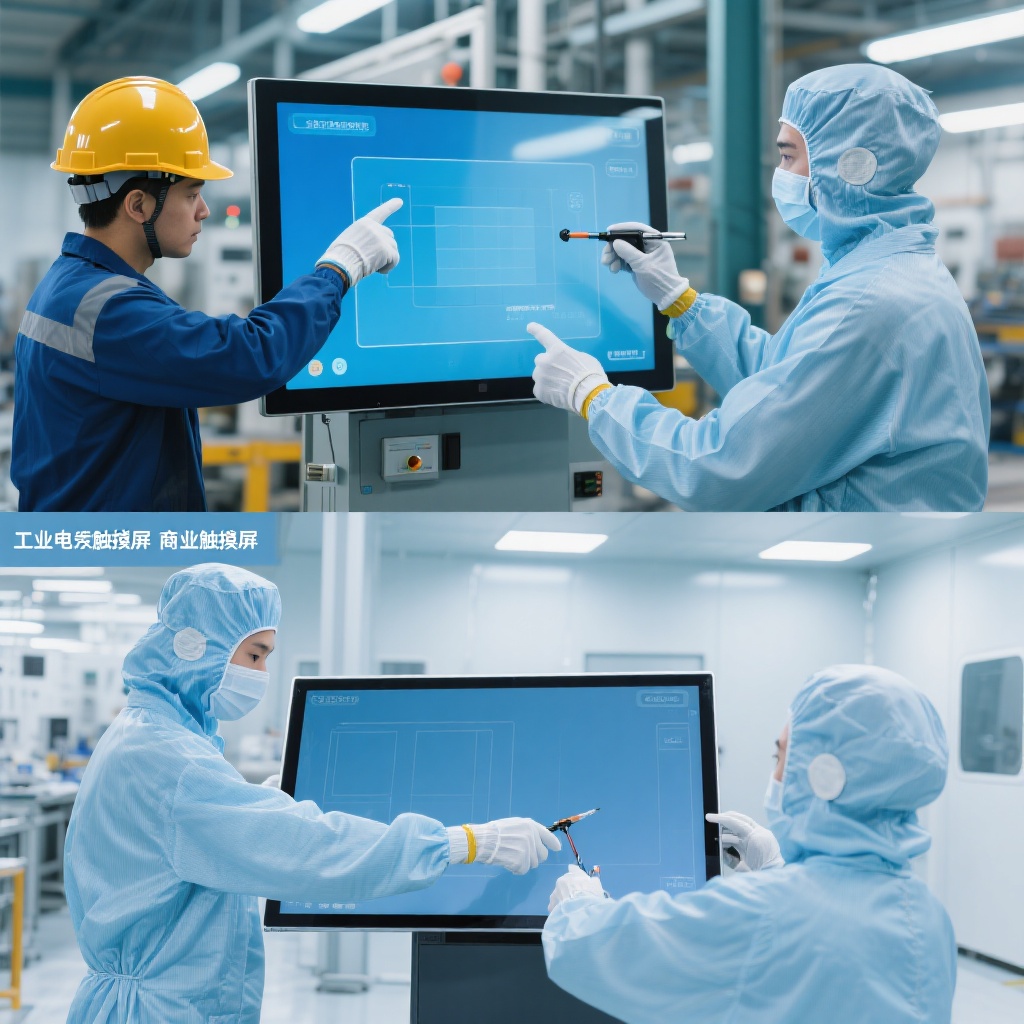
Industrial Capacitive Touchscreens
The primary design goal is to adapt to harsh industrial environments, ensuring stable operation under various interferences.
Environmental Adaptability: They must operate normally in environments with wide temperature ranges (e.g., -10℃ to 60℃ or even higher), high humidity,
high dust levels, and oil contamination. Products must be waterproof and dustproof certified, with the front panel typically requiring an IP65 or higher
protection rating to resist water or oil splashes.
Interference Resistance: Industrial environments contain strong electromagnetic interference sources such as motors and frequency converters. Industrial
capacitive touchscreens must possess extremely strong electromagnetic interference (EMI/ESD) resistance. For example, frequency hopping technology
is used to avoid interference in specific frequency bands, and special noise reduction algorithms and shielding designs are employed to ensure stable
touch signals.
Durability and Operational Compatibility: The screen surface requires extremely high hardness (usually tempered glass) to resist scratches and impacts.
To accommodate workers wearing gloves, industrial screens offer a "glove mode," which uses adjusted electric fields or algorithms to detect touches
through gloves. Their touch lifespan is typically required to reach tens of millions of touches.
Connectivity and Installation: Power input often uses more reliable lockable Phoenix terminals for industrial applications and supports standard
industrial mounting methods such as VESA, facilitating integration into racks or equipment.
Commercial Application Capacitive Touch Screens:
The core design focus is optimizing the everyday user experience for general users while controlling costs to achieve widespread adoption.
Interactive Experience: High sensitivity, smooth touch response, and precise multi-touch (e.g., 10-point touch) are prioritized. Rich gesture controls
(zoom, swipe) are supported to provide an intuitive experience similar to a smartphone.
Display Performance: High transmittance, high contrast, and vibrant color reproduction are crucial for optimal visual appeal. Full lamination with
the display screen is often used to reduce glare and improve image clarity.
Cost and Appearance: While ensuring basic durability (such as scratch resistance), material and manufacturing costs are strictly controlled. The design
prioritizes a slim, stylish, and aesthetically pleasing appearance to attract consumers.
Usage Environment: Primarily designed for relatively stable and clean indoor environments (such as offices, homes, and shopping malls). Environmental
tolerance and protection requirements are significantly lower than for industrial products.
To help you understand this more intuitively, I have summarized their key differences in the table below.
| Comparison Dimensions | Industrial Application Capacitive Touchscreens | Commercial Application Capacitive Touchscreens |
| Core Design Goals | Reliability, stability, environmental tolerance | User experience, visual appeal, cost control |
| Typical Operating Temperature | Wide temperature range (e.g., -10℃ ~ 60℃) | Normal temperature range (e.g., 0℃ ~ 50℃) |
| Protection Rating (Front Panel) | High (typically IP65/IP66 and above) | Low or none (daily scratch resistance) |
| Touch Characteristics | Supports glove/wet hand mode, strong anti-interference | Excellent bare-hand operation experience, smooth multi-touch |
| Durability Requirements | Extremely high, lifespan of tens of millions of cycles, shock and vibration resistant | General, meets daily usage frequency |
| Electromagnetic Compatibility (EMC) | Strict requirements, specifically designed to pass industrial EMC testing | Meets general standards for consumer electronics products |
| Installation and Interface | Industrial terminals for easy panel/rack mounting | Consumer-grade interfaces for a slim and integrated design |
| Cost Considerations | Total lifecycle cost (including maintenance), high unit price | Material and manufacturing costs, focusing on cost-effectiveness |
Summary of Similarities and Differences
Similarities: Both are based on projected capacitive touch technology, and their core principle is to detect changes in capacitance caused by touch.
They both offer multi-touch capabilities and better light transmittance and durability than resistive touchscreens.
Differences: The fundamental difference lies in their application scenarios. Industrial screens are designed for the "environment," sacrificing some of the
ultimate tactile feel in exchange for survivability in oil, vibration, electromagnetic interference, and extreme temperatures. Commercial screens, on the
other hand, are designed for "people," focusing on pleasing the user's senses, but may not function reliably in complex and harsh industrial environments.
Selection Recommendations
In short, if your equipment will be used in factory workshops, outdoors, medical settings, or environments with oil and vibration, prioritize industrial-grade
capacitive touchscreens to ensure stability. For indoor consumer electronics, self-service kiosks, or devices with extremely high requirements for aesthetics
and tactile feel, commercial-grade capacitive touchscreens are a more suitable and economical choice.
If you are unsure how to choose a suitable product, please contact us, and we will recommend appropriate options.
+0086 755 21042870
+0086 755 2822 5493
Shenzhen Company: 5/F, Building 211, Tairan Science Park, Tairan 4th Road, Shatou Street, Futian District, Shenzhen(518040), China.
Dongguan Factory: 2/F, Building D, Fulin Industrial Park, Weixi Road, Dalingshan Town, Dongguan City(523831), Guangdong,China
NAVIGATION
REQUEST A QUOTE